I've added Consciousness Raising Facts & Questions for the value Care/Nurture at: https://www.mvf-knowledge-base.com/p/128-values.html
Eventually I will complete all 128 Values :)
Monday, 11 April 2022


Saturday, 26 March 2022
What is a Community of Practice [CoP]?
We've updated our What is a Community of Practice [CoP]? Page, in particular emphasizing that our Minessence Group is a CoP for people using the Minessence Values Framework in their practice.
Friday, 19 November 2021
Layout Update
We've updated our MVF Knowledge-Base Blog's layout to make it simpler to find resources.
We added:
● Our Logo ← clicking on it will take you to our website
● A Blog Search widget
● A Contact Form so you can easily send us feedback or requests
● A Post List to access past posts.
Friday, 8 March 2019
The Entropy Paradox
Nobel Prize physicist Erwin Schrödinger wrote a book in 1944 with the title What is Life? It has been described as one of the most influential books in the history of science. Its object was to investigate the extent to which life could be accounted for in terms of physics and chemistry, despite our 'obvious inability' to define life. He had two themes--'order from disorder' and 'order from order'. Order from disorder emphasised that life fed on negative entropy, which is a way of saying that whereas the universe as a whole is becoming less ordered (positive entropy) life creates greater order (negative entropy). This is not an exception to the rule of the universe for the rule simply states that, whereas the universe as a whole is running down, there are enclaves where the opposite may happen and one such enclave is human organisms. There is nothing mysterious about this. Living organisms get their energy to do this from the sun. The sun's energy is trapped by plants. Animal get their energy from feeding on plants...
Schrödinger's second principle 'order from order' was about how information was passed from generation to generation by genes. he predicted the general nature of the gene more than a decade before the structure of DNA was understood. [Birch 1999, p. 4]
Entropy is the only quantity in the physical sciences that requires a particular direction for time, sometimes called an arrow of time. As one goes "forward" in time, the second law of thermodynamics says, the entropy of an isolated system will increase. Hence, from one perspective, entropy measurement is a way of distinguishing the past from the future. However in thermodynamic systems that are not closed, entropy can decrease with time: many systems, including living systems, reduce local entropy at the expense of an environmental increase, resulting in a net increase in entropy. Examples of such systems and phenomena include the formation of certain crystals, the workings of a refrigerator and living organisms.
Since entropy is the measure of disorder, we can easily create a relative measure of it for any group of people for “equal priority = no priority = chaos = high entropy”, conversely "strong & clear priorities = strong focus = well-defined values-system (strange-attractor) = understandable order = low entropy". This means all we have to to measure the relative entropy of groups, is to undertake an analysis of their value priorities. High group priorities and only a few values will be low entropy and a well focused group. Low group priorities and a large number of shared priorities means high entropy and a low focused group.
The diagram below shows the life-cycle of an organisation or group of people:

Figure 1. Group/Organisational LifeCycle
- At foundation and boom, entropy is low because shared values are few and priorities are high—strong norms which guide behaviour will emerge
- In the period of decline, entropy becomes higher and higher because shared values become many and their collective priorities are low—a state of anomie exists when norms break down-- many people are doing their own thing—the organisation/group is becoming chaotic
- The group/organisation's only chance of surviving and again becoming successful is to rebuild a robust values-system (strange-attractor)--when this is in place the entropy will again be low.
Keeping track of group/organisation's entropy is a way of keeping track of the group/organisation's health. When entropy starts to rise, alarm bells should be ringing.
The Entropy Paradox
While it's important for an organisation's entropy to be low. For individuals, growth depends on them following a regular entropy cycle as depicted in Figure 2. The top of the diagram represents a person working from their primary brain-preference modes. Here they are most competent and dependable. However, if they never engage the other parts of their brain their development will be stunted. It is important that everyone in the organisation is given the freedom and encouragement to undertake fun activities matching their least brain preference on a regular basis (at least two hours per week). This will unlock their creativity, and lead to holistic brain development--i.e. their brain becomes more complex, and though they are cycling through low to high entropy, in the long run their brain entropy will be decreasing. Hence the paradox, people need to feed off periods of chaotic fun activities (high entropy) in order to be more creative, more sophisticated (low entropy) individuals.

Figure 2. Entropy Cycle
In summary, people have to be given their space, time & freedom in organisations so they can have fun in their creative mode—the saying, "All work and no play makes Jack/Jill a dull boy/girl” turns out to be a key principle behind personal development. Mihaly Csikszentmihalyi, in this video, gives a few good examples of people who have this freedom. The Australian movie The Dish also gives a good example of an organisation which is maximally effective and successful because its people are continually moving through the entropy cycle.
Entropy should not be a static measurement, rather the conditions should be set so that people can cycle through it. A good measure which shows if an organisation is “ripe” for enabling this cycle to exist in an organisation is the leisure/pleasure score in the diagram below:

Figure 3. The Cultural Field Map
An organisation with a low or zero leisure/pleasure score and a high control/order score would be a low entropy (i.e. orderly and boring) organisation. On the other hand, an organisation with a moderately high leisure/pleasure score and a low control/order score would be an even lower-entropy organisation yet be a fun creative place to work, provided it has a clearly defined values/vision/mission statement based on its people own values, and, encourages teams with a diversity of brain-preference to engage in regular creative mode activities. It has a lower-entropy than the highly controlled no-fun organisation because it is more complex/sophisticated in its operation--you could say, it's more alive! The Chaordic Model (Figure 4), in conjunction with the values alignment model of Figure 5, are designed to create such an organisation.

Figure 4. The Chaordic Model of Organisational Development

Figure 5. Organisational Alignment Model
To create a low-entropy high performing organisation, each person and each group in the organisation must give attention to:
- Concretization. Concretizing their priority vision, focus and vision values (using techniques such as: asking VAK questions about each value, concept mapping, and/or Repertory Grid). "Until you make the unconscious conscious, it will direct your life and you will call it fate." - Carl Jung
- Purpose. Having regard any published organisational values, formulate personal and group values, vision and mission statements. Make statements which are uplifting and motivating. "Where there is no vision, the people perish." - Proverbs 29:18
- Will. Each person reflects on their foundation and vision values, and brain-preference. Vision values motivate so, "Will this organisation enable you to be passionate about and motivated by your vision values?" Foundation values can demotivate if they are not satisfied so, "Do you have strategies and skills in place that turn these values into a solid foundation rather than an Achilles heel?" "In this organisation/group, are you able to focus mainly on tasks which match your work-mode brain-preferences and priority values?"
- "How do your top 10 values compare to your group/organisation's top 10 values?" "What common ground do you see?" "If your values are markedly different to the group/organisation's values, can you see a way you could happily live your own values whilst at the same contributing to the group/organisation's values?" "How does the group energy management profile compare with your personal profile?"
- Capability. "Do all in our group have the skills, resources and abilities to live our values in our workplace?" SQ = Spiritual Intelligence, EQ = Emotional Intelligence and IQ = intellectual intelligence, "Do we have the knowledge to develop these intelligences within our group?" The group skills profile indicates the skills needs of each group based on the values they all have. "What are the implications of this profile for our group?"
The above program works, and it works very well, because it creates low entropy organisation--i.e. an organisation with a strong values-system (strange attractor) sourced in its people's actual values--self-organisation does the rest.
Friday, 13 July 2018
Tuesday, 20 March 2018
Site Update
I am in the process of adding a contents page and as part of setting that up am methodically working through all the material at our MVF Knowledge-Base - updating it as appropriate. Please feel free to make suggestions at our feedback page.
Sunday, 20 August 2017
New Page: 128 Values
New pages have been added to our MVF Knowledge-Base Blog. The 128 Values of the Minessence Values Framework now have their own page. The values are listed at https://values-knowledge-base.blogspot.com.au/p/128-values.html and each value is to have its own separate page. Clicking on a value in the 128 Values page will take you to its page. I've started with value 40: Empathy. Over the next few weeks I add a page for each of the other values.
Thursday, 4 February 2016
Values Tracks/Themes
What is Organizational Culture?

"Culture eats strategy for breakfast, operational excellence for lunch, and everything else for dinner.”
Peter Drucker
Organizational culture is the unique way that an organization forms and defines itself in terms of its shared values, worldviews, principles, traditions, customs, rituals, stories, practices and unwritten rules that distinguish it from other organizations. This includes the ways the organization conducts its business, treats it employees, customers and the community of which it is a part. Its culture affects its productivity, customer service, marketing and advertising practices, HR policies and capacity for innovation. Increasingly, it also includes its environmental and social responsibility practices. Organizational culture is unique for every organization and is one of the hardest things to change. It is influenced by national culture as well. It is also well established that organizational culture is a significant barrier to successful mergers and acquisitions. Most mergers fail due to cultural incompatibilities. A 2015 KPMG study indicates that 83% of merger deals do not boost shareholder returns because of the failure to manage cultural issues.
Organizational Values Tracks
Organizational Culture may be also understood as an emergent property of its Values System and is measured and profiled through analysing how the values combine to work together as Values Tracks or themes that illustrate the shared beliefs about “how things should be done around here”.
Each organizational Values Track contains multiple values that are profiled in our Organizational Culture Values Inventory report. This report identifies the primary Values Tracks for a group, team or an entire organization and can help to determine which types and combinations of group values, and their priorities comprise its culture. The chart below illustrates an example of the combination of values and their measured priorities for the Values Tracks of Customer Focus and Learning & Innovation for a senior team within the Minessence International COOP.
Example Values Tracks and Their Values

Organizational Values Tracks as a Strange Attractor
The diagram below shows three other example Values Tracks which relate the values and beliefs of people in an organization to how they act (Action), how they create organizational structure (Order) and whether they are doing things primarily for their own benefit or to add value to their clients (Share).

Values are both primary individual and group motivators. Values Tracks which coalesce within an organization become a collective pattern which motivate group behaviours and can profile organizational culture. These patterns are called Strange Attractors.
Strange Attractors create a certain form of order within any complex non-linear system be it the weather, a bushfire, the stock market, societal cultures, an organization, a team or an individual person. For living entities, their values system is their Strange Attractor.
Why do we use the term Strange Attractor instead of simply referring to values as attractors?
The term Strange Attractor comes from the study of complex systems which exhibit "order within chaos". Chaos Theory and non-linear system researchers discovered that certain entities behaved in strange ways yet their behaviours were obviously being influenced by a strong attraction to something. Attractors which led to entities behaving in strange and not entirely predictable ways became known as Strange Attractors. Attractors which lead to predicable behaviours are termed ordinary attractors. Gravity is an example of an ordinary attractor. With ordinary attractors such as gravity, one can mathematically compute exactly what will happen in the future. For example, if a person drops a ball from 1-meter height, it can be calculated precisely when that ball will land. When an entity's behavior (motion, actions, path, etc.) is governed instead by a Strange Attractor, one cannot predict what will happen in the future, however, one can predict the general form or nature of what will unfold.
For example, a person with priority values of achievement, competition, work, financial success, and duty will be attracted by these values to behave in a completely different way to someone who has priority values of expressiveness/freedom, play, intimacy, search/meaning, service, equity/rights. Clearly in both these examples you cannot know what each person will do moment to moment, however, you will know with a fair degree of certainty the general nature of how they will behave as their life unfolds. For each person, their values-system (in its role as a Strange Attractor) gives a sense of order to their life. So it is with teams, organizations and different cultural groups.
One explanation of the way Strange Attractors work is to consider fish in an ocean. As the water moves in synchronism with the current or swell, the fish all appear to move together from side to side or up and down as though connected by some invisible connector-- of course, we know that it is the water of the ocean. A similar phenomenon is seen in flight patterns of birds. Strange Attractors behave the same way: we cannot see them and they (unlike the water of the ocean) have no material substance, yet, they link all material objects. In Newtonian Physics physical reality is considered to be solely a material reality. The existence of Strange Attractors has caused us to change our notion of reality since no one will dispute that they are real, but they have no material substance. This is a working assumption of Quantum Physics.
Translated into our understanding of modern organizations, we can differentiate a Newtonian Science Organization from a Quantum Science Organization.
The Newtonian Science Organization
|
The Quantum Science Organization
|
An organization is a collection of choices looking for problems, issues and feelings looking for decision situations in which they might be aired, solutions looking for issues to which there might be an answer, and decision makers looking for work.
|
Organizational order is provided through motivational energy ordered by Strange Attractors. Order is thus created and maintained through conceptual controls–people's values, ideas and beliefs are creating the order, not some manager with authority. The strongest motivational energy emanates from shared meaning–the source of the organization’s values-system–the Strange Attractors which create and maintains its culture.
|
Organizational Culture Values Tracks
The example above looked at how values may coalesce to form a Strange Attractor along just three dimensions or tracks: Action, Order & Sharing. The Minessence Values Framework typically uses eight Values Tracks to analyze the Strange Attractor(s) shaping an organization’s culture:
- Creating Value (multiple bottom lines)
- Customer Focus
- Learning & Innovation
- Respect, Trust & Openness
- Team Work & Collaboration
- Organizing/Creating Order
- Resilience & Renewal
- Social & Environmental Responsibility
The following diagram illustrates the pattern of Values Tracks (motivational energy) which emerges from the coalescence of values priorities of a senior team within our own Minessence International COOP organization.

Monday, 2 March 2015
What are Energy Field Maps [EFMs]?
Although we know a great deal about the way fields affect the world as we perceive it, the truth is no one really knows what a field is. The closest we can come to describing what they are is to say that they are spatial structures in the fabric of space itself. [Talbot]
Newton’s world of cause and effect required great effort (forces) to make things happen. Since the emergence of the quantum world, we see that it is possible to accomplish this through manipulating non-material structures–i.e. fields–which are the basic substance of the universe.
One explanation of the way fields work is to consider fish in an ocean. As the water moves in synchronism with the swell, the fish all appear to move together from side to side or up and down as though connected by some invisible connector. We know that it is the water of the ocean, however, fields in space behave the same way, we cannot see them and they (unlike the water of the ocean) have no material substance, however, they link all material objects in space. “Physical reality is not only material. Fields are considered real, but they are not material” (Wheatley 1994 p. 50).
| The Newtonian Science Organisation | The Quantum Science Organisation |
| An organisation is a collection of choices looking for problems, issues and feelings looking for decision situations in which they might be aired, solutions looking for issues to which there might be an answer, and decision makers looking for work. | Organisational order is generated through fields. These fields are conceptual controls–it is the ideas of a business that are controlling, not some manager with authority. One of the most powerful fields is shared meaning or the unconscious common ground within an organisation. |
In the field view of organisations, clarity about values or vision is important, but it’s only half the task. Creating the field through the dissemination of those ideas is essential. The field must reach all corners of the organisation, involve everyone, and be available everywhere. We need to imagine ourselves as broadcasters, tall radio beacons of information, pulsating out messages everywhere. We must fill all the spaces with the messages we care about. If we do that, fields develop–and with them, their wondrous capacity to bring energy into form. [Wheatley]
Inspired by Tosey and Smith (1999), we have developed an Energy Field Map [EFM] (used with individuals) or Cultural Field Map [CFM] (used with groups) to facilitate the understanding of values-systems from an energy field perspective. Each dimension of the chart is a field of motivational energy emanating from the underlying values.

The pattern in the centre of the hexagon above maps your priority value priorities on each of eight motivational energy field dimensions.
Key questions to ask are:
Key questions to ask are:
- Which are the strongest fields?
- Which are weakest or non-existent?
- Given this is the motivational energy I am 'radiating' to those around me, how will people relate to me?
- What would they see me doing?
- What would they hear me saying?
- How would they feel in my presence?
- How does the pattern of my energy fields compare that of my team or organisation?
- What does this mean for myself and those with whom I work?
Saturday, 2 August 2014
True Dialogue--The only 'sure-fire' way to see the 'elephant in the room'
An ancient Indian folk tale explains how we each have different perceptions of the world. Some
Hindus had brought an elephant for exhibition and placed it in a dark house. Six men, who had never
seen an elephant, went into that dark place, one at a time, to see the elephant. Finding that in the
darkness, visual inspection was impossible, they felt it with their hands.

On coming out, each explained to the others:
- The palm of the first fell on the trunk. "This creature is like a snake," he said.
- The hand of the second lighted on an elephant’s ear. "Oh no," he exclaims, "It's like a large leaf."
- The third man felt a leg. "I found the elephant’s shape is like a tree," he said.
- The fourth caught hold of its tail, "Nonsense, an elephant is just like a rope."
- The fifth man placed his hands on the side of the beast, "It's just like a brick wall," he said.
- The last man, feeling a tusk, asserts, "You are all wrong, it's like a sharp spear!"
Moral of the Story...
No one sees anything from all points of view.
Only through sharing points of view,
can we come close to "seeing" the whole.
Each of us has a unique view of the world which includes a set of beliefs about the nature of the world in which we live. Beliefs about:
- The nature of human relationships (hierarchical, collaborative, individual),
- The nature of human nature (evil, mixed, good),
- The nature of human activity (being, becoming, doing),
- The nature of our time sense (past, present, future),
- The nature of our relationship with the environment (subordinate to nature, harmony with nature, dominant over nature). etc.
These beliefs structure our view of the world. In turn, our personal world-view gives rise to a unique set of personal value priorities. The reverse is also true. Knowing a person's value priorities, makes it possible to gain insights into how a person views the world.
Only through true dialogue, in a genuine effort to understand each other's worldview (i.e. understand why we each see what we see and why we each believe what we believe), can we create a peaceful world.
See also: Empathy: The Preeminent Value
Friday, 16 November 2012
Transformative Leadership

Transformative leadership is a team effort. It requires constructive dialogue between Transactional leaders (the implementers) and Visionary leaders (the dreamers). It's through the dialogue between these two groups that a new tacit worldview emerges. So who are the Visionary Leaders, and who are the transactional leaders?
From when we are born our interaction with the world around us stimulates our brain. We quickly begin to develop preferences for some forms of stimulation over others. By late adolescence these preferences are virtually "set in concrete" and we have developed a preference for one of four ways of relating to the world around us: things-abstract, concrete-things, concrete-people, or people-abstract. Below, each of these four ways of dialoguing with reality are briefly described along with preferred leadership modus operandi.
Things-Abstract [Technical Architect]
These are people who have a preference for using their hands to "tinker" with or to create things and to use their intellect to develop models or plans. They rely mostly on discovering things about the world through thinking about it and intellectually analysing it. They prefer to gather information visually. They are the "accidental leaders" because they will often create a technology which everyone else wants. People such as Bill Gates and the inventor of Facebook are examples. People with this brain-preference are not particularly interested in politics, they are the "corporatists" and would be quite comfortable living a totally privatized world.Those who belong to this brain-preference will be seen as visionary leaders if people like the technology they have created.
Things-Concrete [Quality Producer/Crafts Person]
These are "hands on" people who like certainty and like activities/organisations to be well structured. They prefer things to be down-to-earth rather than abstract and intangible. People with this preference may be athletes, mechanics, surgeons, gardeners, accountants, farmers, etc. They will prefer a political party which gives them certainty and a sense of security. They will also prefer a party which is conservative in its policies rather than one which comes up with innovative new (never-tried-before) policy.These people can be fabulous transactional leaders. Those who are masters of their craft will be sought out to teach others the best way to perform their chosen occupation.
Concrete-People [People Servants]
As with the Quality Producers, People Servants like structure. However, their preference is for spending time with and talking to people, rather than relating to the world of non-human things. They will choose careers as school teachers, actors, ethicists, priests/nuns, public servants, value consultants, etc. They will also prefer a party which is somewhat conservative in its policies, however, they will put people ahead of balancing the budget. So, if their party spends too much money on welfare (i.e. caring for those who can't care for themselves), their party will probably be voted out of office and a party supported by the Quality Producers will be voted back in on the promise of spending cuts to bring the budget back into surplus.
People Servants are great facilitators, they are key to facilitating the oft difficult dialogue between the Visionary Leaders and the Transactional Leaders. Without this dialogue transformation is not possible. Understanding the worldviews and values of each group is essential to facilitating effective dialogue.
People-Abstract [Social Architects]
The Social Architects, like the People Servants, prefer the world of people to the world of non-human things. Social Architects are comfortable functioning in a world of uncertainty--in fact it's their preference--too much of the "same old, same old" and they get bored. Social Architects like to create models to understand how people behave, they like designing new social systems. They are the "greens", social-ecologists, social-activists, social scientists, social policy planners, etc. in our society.
These people are potential Visionary Leaders in respect of societal and/or organisational change. As with the facilitators, to be effective as a visionary leader they must be able to gain rapport with those the desire to influence. Remember, the key is to change is firstly gaining real rapport with people. And, for genuine rapport to exist, people must really know that you are able to see the world through their eyes and therefore understand what they have the values they have.
* * * *
In the video below, Matthew Taylor describes just how essential to our future are the coexistence of structure (maintaining world-views/transactional leadership), commitment and cohesiveness (the facilitative leader/mediator), and innovation (visionary leadership).
Monday, 12 March 2012
If morality is broken, we can fix it
There's an excellent article in New Scientist [18 February 2012; p. 3] titled, "If morality is broken, we can fix it". The intro to the article reads, "SCIENCE has made great strides in explaining morality. No longer is it seen as something handed down from on high; instead it is an evolved system of enlightened self-interest. Altruism, for example, can benefit your genes and disgust can protect you from disease. This picture is progress, but it can also lead to a kind of fatalism, a belief that our moral values evolved for a good reason and so we should stick to them.
"Yet some value judgements are difficult to fit into this framework. Why is it acceptable to take certain drugs but a criminal offence to take others? Why is it wrong to create human embryos to cure diseases endured by millions?
"Now an experiment suggests that morality isn't entirely about evolutionary benefits to individuals [New Scientist, 18 February 2012; p. 10]. We also have an evolved tendency to make and obey arbitrary moral rules, probably as a way of promoting social cohesion.
"That picture opens the door to more progress. Yes, we follow rules that bring little benefit and can even be positively harmful. But the rules are not set in stone, so there's nothing to stop us getting rid of those that don't work and putting better ones in their place."
Saturday, 10 December 2011
What's the Minessence Group's Take on Memes?
Memes are ideas, tunes, inventions, retorts, ways of doing business, ways of asking for help, and ways of saying hello. (Palumbi 2001, p. 243)Over the past few decades there has been a shift in thought concerning the evolution of human culture. Ever since Dawkins, in his book The Selfish Gene, coined the term “meme” as the selfish unit of societal evolution analogous to the gene’s role in the evolution of species, there’s been a groundswell of people focussing on the evolution culture via memes.
Dawkins suggested that memes, composed of memory and imagination, were the basic replicating units through which human culture evolved. Yet, memes simply do not fit the model of classic Darwinian evolution.
Ideas are not passed on from one generation to another in a linear fashion as are genes. Most often, each person adds their own slant to an idea or may simply not understand it properly and pass on some distortion of the original (Chinese whispers). Also, people’s values have a profound impact on the transference of ideas. Values filter what people give attention to—people don’t even notice, let alone pass on, ideas which would make no contribution to what they value. People may also deliberately make a conscious choice to pass on, or not to pass on, particular ideas—knowledge is power.
The main distinction is: Darwinian evolution is about the survival of the species which, by chance, have adapted to change in a way which avoids their extinction; whereas, the survival of ideas depends on complex values dynamics:
The impact of conscious selection at the stage of idea mutation and transmission blurs the distinction among the three elements of Darwin’s engine and suggests a very different way of looking at ideas than Dawkins’s notion of evolving memes. Picked over as carefully as meatballs at a cheap buffet, ideas are sorted by the finicky process of conscious selection. They are created, used, and discarded by active minds seeking their own advancement or their own comfort. What other element of our lives do we consciously improve for better function and pick carefully among to fill our cultural shopping carts? We can also consider ideas as tools.Q. If memes are not the mechanism by which culture changes, what is? A. Changes in the culture's values-system, i.e. changes t its strange attractor.
As tools, ideas may be practical or not. They may have general or specific uses. Others may shun them or adopt them with gusto. Sometimes they seem to have a life and independence of their own, like the wooden handle of an axe that becomes polished through use to fit the hands that wield it. But in the final analysis they remain tools, ways of manipulating the world or understanding it. They do not evolve like genes because like tools, they cannot really replicate themselves—they can be made only on demand by brains, and only by this agency can they spread through to other brains. This does not say they always benefit us—akin to the way many of us have tool boxes stuffed full of things not currently doing us any good—and it does not claim that they can never do damage—like an unchaperoned gun. But the function and rapid change of ideas does not require their independent evolution...(Palumbi 2001, p. 252)
Thursday, 8 December 2011
How do I Become an Evolved Person?
People often write about levels of consciousness which is curious, since no one yet even knows what consciousness is, let alone able to define levels of this elusive concept!
Brian Hall (Figure 1), Clare Graves (Figure 2) and others go so far as to suggest that human development is correlated to levels of consciousness.
 |
| Figure 1. Stages & Phases of Human Development (Source: Brian hall) |
Clare Graves goes further than Hall's global consciousness level, seeming to imply there's no limit (Figure 2):
 |
| Figure 2. Levels of Human Consciousness Development |
Supposedly, any person who has the global level consciousness of Hall's model, or is at level 10 or above of the Graves model, is an evolved person. There are two flaws in these and similar models of human development:
- Evolution cannot be tied to growth, development, progress or any other like concept. Identifying someone is an evolved person actually says nothing about who they are as a person, in fact the statement is rather meaningless.
- Levels of consciousness cannot be tied to values development.
Let's look at these flaws in more detail...
Evolution Cannot be Tied to Growth/Progress
Figure 3 is a typical technology timeline advertisement which explicitly assumes a link between evolution and progress:
 |
| Figure 3. Linking Evolution & Progress |
However, Darwin himself pointed out that evolution is only about species adapting to change--those which adapt appropriately survive. It's about the continued existence of the fittest to survive. Those which survive are not better or more intelligent that those which didn't survive. They are simply those which survived because, by chance. they adapted to changed conditions in a way which prevented them from becoming extinct. The current evolution of the human species looks more like that depicted in the two cartoons of Figure 3:
 |
| Figure 3. Evolution of Man (Note: Not sexist, just couldn't find equivalent cartoons with women in too) |
If progress really was tied to evolution one would perhaps have expected a result more like this:
 |
| Figure 4. An Evolutionary Fantasy (sorry still sexist) |
The cartoons of Figures 2 & 3 represent canonical icons--i.e. iconic depictions of an unconscious belief-set (in this case, a false belief-set) embedded in the psyche of Western culture. Interestingly, as highlighted by the side notes in the captions, these canonical icons are also linking males to evolution and progress. Figure 5 is the only one found which did include a female. How do you react to this image? Is it a cynical dig at the male concept of evolution and progress? Or, is it just using sexual imagery to promote something?
 |
| Figure 5. What's the Canonical Message? |
In summary, there's no link between evolution and progress. In fact, letting this false belief guide our collective behaviour is a form of "cop-out": we don't have to think, put the brain in neutral and let random selection create a better world for us--"Sorry. It ain't gonna happen!"
Levels of Consciousness Cannot be tied to Values Development
What is consciousness? For starters, consciousness is not like an on-off switch where we are either conscious or unconscious. It's more like a dimmer switch, where it can go through a continuum from were you are totally disconnected from the world (asleep or in a coma) to the other end where you are totally pre-occupied with some worldly issue be it operating one someone's brain, repairing a car motor, writing a song, solving the problems of the world with a colleague, landscaping the garden...(Greenfield, 2000)
Latest neuroscience (Geddes, 2011) has identified that consciousness is correlated with the synchronisation process of brain activities. The more our brain is involved in connecting all the dots, the more conscious we are. When we are most conscious, paradoxically, we disconnect from the world around us (our senses are effectively "turned off") and we lose track of time--we are in a state Czikszentmihalyi (1992) describes as flow...
Figure 6 is a simplified version of the diagram Czikszentmihalyi uses in his video.
 |
| Figure 6. Commensurate Increases in Challenge & Skills Creates Flow Experiences |
Raised consciousness (flow experience) is linked to skills development. The link with values stems from the fact that we are only ever self-motivated to take on challenge and skills associated with activities which match our values.
So the term evolved person is rather meaningless because there's no link between evolution and progress or development. So lets re-frame the question to, "How do I use my values to guide my personal development." Answer:
- Know and live your own values ("If you are not living your values, whose values are you living?)
- Continually seek to increase your skills in living your values using the model given in Figure 6 and explained further in the animate.
- Because we are part of nature, we cannot live our values any way we want, so live your values in consideration of other life on this planet.
Put simply, personal growth is synonymous with values-based skills development.
Click here for a case study where this approach is applied to living the value health/well-being.
Wednesday, 7 December 2011
What's the Difference Between Values, Ethics & Principles?

The short answer: "Values
motivate, ethics and morals necessarily constrain (because we live in a society, we cannot live our values any way we
want)."
Values describe what is important in a person's life, while ethics and morals prescribe what is or is
not considered appropriate behaviour in living one's life. Principles inform our choice of desirable
behavioural constraints (morals, ethics, rules, laws, etc.).
"Generally speaking, value refers to the relative worth of a quality or object. Value is what makes
something desirable or undesirable" (Shockley-Zalabak 1999, p. 425). Through applying our personal
values (usually unconsciously) as benchmarks, we continually make subjective judgments about a whole
manner of things:
...we are more likely to make choices that support our value systems than choices that will not. Let us say that financial security is a strong value for an individual. When faced with a choice of jobs, chances are the individual will carefully examine each organisation for potential financial and job security. The job applicant who values financial security may well take a lower salary offer with a well established company over a higher-paying offer from a new, high risk venture. Another job seeker with different values, possibly adventure and excitement, might choose the newer company simply for the potential risk and uncertain future.
Values, therefore, become part of complex attitude sets that influence our behaviour and the behaviour of all those with whom we interact. What we value guides not only our personal choices but also our perceptions of the worth of others. We are more likely, for example, to evaluate highly someone who holds the same hard-work value we do than someone who finds work distasteful, with personal gratification a more important value. We may also call the person lazy and worthless, a negative value label.
What then of ethics? Ethics are the standards by which behaviours are evaluated for their morality - their
rightness or wrongness. Imagine a person who has a strong value of achievement and success. Knowing
only that this value is important to them gives us a general expectation of their behaviour, i.e. we would
expect them to be goal oriented, gaining the skills necessary to get what they want, etc. However, we
cannot know whether they will lie or cheat to get what they want or "do an honest day's work each day".
The latter dimension is a matter of ethics and morality. Take another example, a person has a high priority
value or research/knowledge/insight. They have have a career in medical research. In fact, knowing their
value priority we would expect them to have a career in some form of research, however, we do not know
from their value priority how they are likely to undergo their research. Will the person conduct
experiments on animals, or would they abhor such approaches? Again, the latter is a matter of ethical
stance and morality. Johannesen (cited Shockley-Zalabak 1999, p. 437) gives further examples which help
distinguish between values and ethics:
Concepts such as material success, individualism, efficiency, thrift, freedom, courage, hard work, prudence, competition, patriotism, compromise, and punctuality all are value standards that have varying degrees of potency in contemporary American culture. But we probably would not view them primarily as ethical standards of right and wrong. Ethical judgments focus more precisely on degrees of rightness and wrongness in human behaviour. In condemning someone for being inefficient, conformist, extravagant, lazy, or late, we probably would not also claim they are unethical. However, standards such as honesty, truthfulness, fairness, and humaneness usually are used in making ethical judgments of rightness and wrongness in human behaviour.
To summarise then, values are our measures of importance, whereas ethics represent our judgments about
right and wrong. The close relationship between importance and right and wrong is a powerful influence
on our behaviour and how we evaluate the behaviour of others.
Q. How does one go about choosing what ethics, morals, rules, laws, etc. are 'right'?
A. By basing them on appropriate principles.
The Principle Centric Approach to Behavioural Choices
Principle is defined in Nuttall's Concise Standard Dictionary of the English Language as, "Principle. n the
source or origin of anything; a general truth or law comprehending many subordinate ones; tenet or
doctrine; a settled law or rule of action; v.t. to impress with any tenet; to establish firmly in the mind."
In this Millennium, perhaps more than ever before, We need to reformulate a set of principles to guide us.
There are two main benefits of taking a principle centric approach to guide all human action: (1) knowing
a set of principles concerning 'the nature of things' enables us to make informed choices and judgments as
we would know, with a high degree of certainty, the likely outcomes of our actions, (2) knowing even a
few principles helps us avoid information overload. On the latter point, Birch (1999, p. 44) says:
Before you raise your voice to protest, "What do scientific principles have to do with informing what constitutes ethical and moral human behaviour?" Stop for a moment and ponder the what has been institutionalised into Western society, all in the name of extolling the virtue of progress through unencumbered evolution--guided by the principles made evident by Charles Darwin: we push for free trade with level playing fields, argue that cloning interferes with natural selection, push for de-regulation so that competition prevails and only the fit organisations should survive, etc., etc.One way in which drowning in information is overcome is by the discovery of principles and theories that tie up a lot of information previously untied. Prior to Charles Darwin biology was a mass of unrelated facts about nature. Darwin tied them together in a mere three principles of evolution: random genetic variation, struggle for existence and natural selection. So we do not need to teach every detail that was taught to nineteenth century students. A mere example is necessary to illustrate the universal principles.
But what if we've got Darwin wrong? What if the principles instead were: survival of those who cooperate for the greater good, selection guided by a moral sense, etc. We would have a completely different society from that which we have today. Internalising the principles we believe explain the nature-of-things is perhaps the single most powerful factor shaping society. It is vital that we maintain a continual dialogue around principles to ensure those we internalise and institutionalise are up-to-date and are our current best shot at the truth. We must work hard to expose those who willingly spread misinformation for their own personal gain--our future depends on it.
We are entitled to our own opinions. We are not entitled to our own facts.
Some examples of principles are:
- People become more trusting the more they perceive they are being trusted.
- The wealth of countries is directly related to the level of trust within the country.
- The greater the trust level, the greater the wealth.
- People reject inequality, even if it means walking away empty-handed.
- Our brain is dichotomous which leads to the fact that many of people's "weaknesses" are a natural consequence of their strengths--rather than try and "fix" these weaknesses, celebrate them.
Google SlideShow
Wednesday, 30 November 2011
Nothing Will Ever Change Until There's a Change of Worldview

Or, as Pirsig says....
...to tear down a factory or to revolt against a government or to avoid repair of a motor cycle because it is a system is to attack the effects rather than the causes; and as long as the attack is upon its effects only, no change is possible. The true system, the real system, is our present construction of systematic thought itself, rationality itself, and if a factory is torn down but the rationality which produced it left standing, then that rationality will simply produce another factory. If a revolution destroys a systematic government, but the systemic patterns of thought that produced that government are left intact, then those patterns will repeat themselves in the succeeding government. There is so much talk about the system and so little understanding. [Emphasis added] (Robert Pirsig, 1974, p. 94)
For change to occur, people need to make different choices in familiar situations. Since values lie behind all our choices, this means people need to undergo a values shift. For a values shift to occur, people's world-view must change. The diagram below shows the main things which shape a person's world-view:

Two of the most powerful influencers of worldview are emotion and the media:
The fastest way of shifting people's world-view is through deliberately provoking a "significant emotive event"--brain washing techniques are an extreme example of this. If you think people would never resort to these techniques, think again! The question we must ask is, are techniques which deliberately provoke "significant emotive events", ethical?
The debate around this issue could rage on for years, however, the debate can be completely side stepped. How? Well it turns out that, though creating significant emotive events is a very effective way of modifying a person's world-view, those provoking the event have no control whatsoever over how the person's world-view will change. If you cannot control the outcome, then what's the point of employing the technique?
How can one be so sure that you cannot control the outcome? It's a basic principle of chaos theory. When you provoke a significant emotive event in a person's life, you create a bifurcation in their meaning-system (i.e. the way they'd made sense of the world until that point in time is broken down--bifurcated!). The brain's system of making sense of the world--it's meaning system--is as about as complex as system as you can get --in fact it might very well be the most complex system in the universe. Chaos theory tells us that when a bifurcation occurs in any complex non-linear system (not just the most complex in the universe) no one can predict the outcome.

So this means, if you deliberately provoke a significant emotive event in a person's life in order to impact on their world-view, you have no control over, nor any way of predicting, what new world-view they will have after the event--how useless then is this as a technique make any change?
"We can't be what we can't see."
Worldview is everything. It shapes our values.
Then, our values determine our choices in life.
In influencing people's worldview, what works best?
What works as both an effective and an ethical means of world-view modification, is the use of a combination of dialogue, experiential learning, and structural change. The key to change is firstly gaining real rapport with people. For genuine rapport to exist, people must really know that you are able to see the world through their eyes and thus really understand why their values are important to them.
Change = Rapport + Information

Tuesday, 29 November 2011
What's the Link Between Values & Skills?
I shall lead you into some territories you’ll find hard to swallow. One of these is the acceptance of one’s “weaknesses” and the idea that weakness is the inevitable counterpart of strength. This is a view that is alien to our scientific-industrial society, which admits only to perfection. If you have weaknesses, the traditional view is to send you to school to correct them. As a consequence, engineers are berated because they write poorly, artists shamed because they are disorderly, and administrators accused of lacking imagination. All this is unfortunate and blind to human nature. The qualities criticised are innate, a consequence of the dichotomous organisation of the mind. Walter Lowen
The level of motivation or the degree of stress you experience is directly related to your ability to "live" your priority values. When you are unable to live your priority values it is because you lack either the skills, support systems, or both. Skills fall into four basic categories:
- Instrumental - tools/hands
- Interpersonal - communications
- Imaginal - creative
- System - making connections/seeing the bigger picture
- Peer - people outside your workplace engaged in similar work to yourself, with whom you can share regularly.
- Work - people in your workplace who give you sustained positive support and you do likewise with them.
- Intimacy - someone to mutually share with at depth on a regular basis.
- Resource - access, as required, to the appropriate mix of skills, abilities and other resources.
It is not a good idea to get peer, work and intimacy support from the same person or group of people. Keep these three support systems separate from each other.
Note: Many values will require one or more of the support systems to be in place in order that you can give full expression to those values in your life.
Through categorising the skills needed to live each of the 128 values, it's possible to produce a chart from your priority values:
 |
| Figure 1. Skills Needs--Determined from Priority Values |
The person, from whose values the above chart was derived, will need mainly interpersonal and system skills to effectively live their priority values.
In the Minessence Values Framework [MVF], growth is more about how you live your values, rather than about living a preferred (according to whom?) set of values. In the MVF, skills, along with challenge, play a very important role in personal growth and development for growth is defined as continually increasing one's level of sophistication (complexity of skill) in living one's values.
Skills & Complexity
A complex world is what we are familiar with. Complexity is normal. It is something we have grown to respect. We stand in awe of nature’s complexity, from the function of the human body to the incomprehensible marvels of microscopic particles. This reverence for complexity has led us to develop our own complex machinery and intricate social support structures. We fail when we confuse “complexity” with “complication”. To messy minds, complicated things are much easier to construct than complex orderly structures. [Nader 1999, pp. 331-332]
It seems that we have been genetically programmed over the past million or so years to seek happiness. It turns out this is no accident, it is necessary for our ongoing survival as a species. The upshot of this genetic programming is that, through our endeavours to do things so we feel good, we each become more and more sophisticated (more complex) beings.
Complexity may be the answer to the age old question, “What is the meaning of life?” the answer being, “To decrease entropy—i.e. increase complexity—in the universe.” The arrow of progress and growth points in the direction increased complexity. It is not surprising, then, that we are genetically programmed to only be happy when we engage in activities that lead to increased complexity.
Csikszentmihalyi (1998, pp. 74-75) describes activities that lead to happiness as flow activities. He believes there is a strong link between flow experiences and the increased complexity of consciousness:
In our studies, we found that every flow activity, whether it involved competition, chance, or any other dimension of experience, had this in common: it provided a sense of self discovery, a creative feeling of transporting the person to higher levels of performance, and led to previously undreamed-of states of consciousness. In short, it transformed the self by making it more complex. In this growth of self lies the key to flow activities.
A simple diagram might help explain why this should be the case. Let us assume that Figure 24 represents a specific activity—for example, the game of tennis. The two theoretically most important dimensions of the experience, challenges and skills, are the diagram's axes. The letter A represents Alex, a boy who is learning to play tennis. The diagram shows Alex at four different points in time. When he first starts playing (A), Alex has practically no skills, and the only challenge he faces is hitting the ball over the net. This is not a very difficult feat, but Alex is likely to enjoy it because the difficulty is just right for his rudimentary skills. So at this point he will probably be in flow. But he cannot stay there long. After a while, if he keeps practising, his skills are bound to improve, and then he will grow bored just batting the ball over the net (B). Or it might happen that he meets a more practised opponent, in which case he will realize that there are much harder challenges for him than just lobbing the ball—at that point, he will feel some anxiety (C) concerning his poor performance.
Neither boredom nor anxiety are positive experiences, Alex will be motivated to return to the flow state. How is he to do it? Glancing again at the diagram, we see that if he is bored (B) and wishes to be in flow again, Alex has essentially only one choice: to increase the challenges he is facing. (He also has a second choice, which is to give up tennis altogether—in which case A would simply disappear from the diagram.) By setting himself a new and more difficult goal that matches his skills—for instance, to beat an opponent just a little more advanced than he is—Alex would be back in flow (D).
If Alex is anxious (C), the way back to flow requires that he he could also reduce the challenges he is facing, and thus return to flow where he started (in A), but in practice it is difficult to ignore challenges once one is aware they exist.
The diagram [Figure 2] shows that both A and D represent situations in which Alex is in flow. Although each are equally enjoyable, the two states are quite different in that D is a more complex experience than A. It is more complex because it involves greater challenges, and demands greater skills from the player.
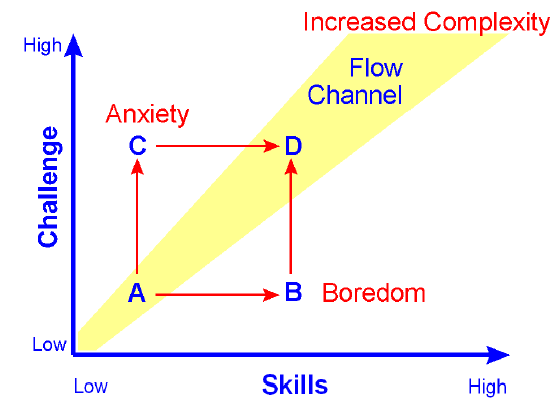 |
| Figure 2. Increased Complexity = Personal Growth |
But D, although complex and enjoyable, does not represent a stable situation, either. As Alex keeps playing, either he will become bored by the stale opportunities he finds at that level, or he will become anxious and frustrated by his relatively low ability. So the motivation to enjoy himself again will push him to get back in the flow channel, but now at a level of complexity even higher than D.
It is this dynamic feature that explains why flow activities lead to growth and discovery. One cannot enjoy doing the same thing at the same level for long. We grow either bored or frustrated; and then the desire to enjoy ourselves again pushes us to stretch our skills, or to discover new opportunities for using them.
In the video below, Csikszentmihalyi gives a more comprehensive explanation of this process.
Tying this all together. The person depicted in Figure 1, to live a happy, meaningful, fulfilling life, must take on ever more challenge in relation to interpersonal and system skills, with a commensurate increase in interpersonal and system skill levels.
Friday, 25 November 2011
Why Value Descriptors in lieu of Definitions?
- Definition--a concise explanation of the meaning of a word or phrase or symbol.
- Descriptor--the phonological or orthographic sound or appearance of a word that can be used to describe or identify something.
 |
| Example Use of Descriptor for Paint |
A descriptor seeks only to provide sufficient information about an entity so it can easily be identified when compared to other entities.
An alternate definition of descriptor is: "a piece of stored information that is used to identify an item in an information storage and retrieval system."
So when a descriptor is used with human values: "A value descriptor is a piece of information used to identify a particular value."
Efficacy
When formulating each value descriptor, the Key Affiliate team used a set of criteria to evaluate the efficacy (capacity or power to produce a desired effect) of each.
To create efficaciousness value descriptors one must:- Identify values which have like roles and work with the identified set of values. (For example, control/order/discipline, law/duty, law/guide, accountability/ethics, etc. all have an ordering role within their respective world-view -- each world-view has different beliefs about how the ordering should be effected, therefore, each world-view has a different value giving expression to the beliefs.) In working with the new descriptors for a set of values, we must ensure the role for each value within its world-view is maintained, and each descriptor clearly distinguishes each value in the set from the others.
- Keep the value label and its descriptor simple using more common-usage words. For example, Collaboration/ Subsidiarity could become Collaboration/ Delegation.
- Use word senses which are the most common interpretation of the word.
- Ensure the descriptor of a value makes it simple to distinguish it from other values, particularly from other values which have labels of like-senses such as, for example: Cooperation/Complementarity, Collaboration/Subsidiarity, and Interdependence.
- Not use other value labels within the descriptor.
- Not provide examples of how the value may be lived -- this narrows the descriptor and could bias its meaning.
- Ensure it facilitates the process of people working through the VAK questions to identify how they are living the value in their life.
- Is it simple?
- Is it constructed from common-usage words?
- Does it use words such that their most common meaning-sense is the sense intended?
- Does it faithfully describe its role in the world-view to which it belongs as a focus value - i.e. is it congruent with the beliefs of its worldview?
- Is it sufficiently different from other values whose labels have like-senses?
- Is it free of other value labels?
- Is it free of examples of how to live the value?
- Is it easily used with the VAK questions?
In IT jargon, a descriptor which meets a set of desired criteria, is be said to be well formed.
Subscribe to:
Posts (Atom)